プレナリーレクチャー
Commemorating the JpGU-AGU Joint Meeting 2026 since 2020 and recognizing the meeting theme of “transformative science for life & Earth,” we present Plenary Lectures at the Makuhari Messe Conference Hall A starting at 12:30 through 13:30 from Monday (no parallel sessions or events in general). The daily schedule is on the right (click to enlarge). Abstracts are available on this page below.
We sincerely hope many researchers will join us, discover new opportunities through these talks, and help realign Earth and planetary sciences toward transformative change. Our speakers challenge us to see the paths ahead more clearly, reconsider the purpose of science, and explore how we can do better. Online access will be made available as with all the scientific sessions from the program timetable after registrants login.
We sincerely hope many researchers will join us, discover new opportunities through these talks, and help realign Earth and planetary sciences toward transformative change. Our speakers challenge us to see the paths ahead more clearly, reconsider the purpose of science, and explore how we can do better. Online access will be made available as with all the scientific sessions from the program timetable after registrants login.
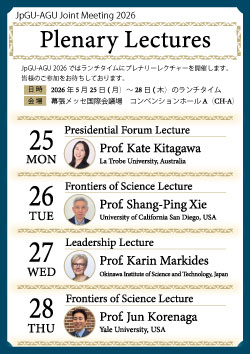
Presidential Forum Lecture : 5月25日(月)
A Space-Age Conversation:
“Thriving in the Space Age: Global Science, New Opportunities, and Expanding Networks”
“Thriving in the Space Age: Global Science, New Opportunities, and Expanding Networks”
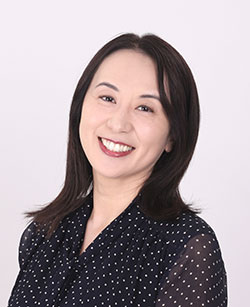
Prof. Kate Kitagawa
La Trobe Univertisy, Australia
La Trobe Univertisy, Australia
北川ケイト(智子)氏は宇宙教育の専門家であり、現在はラ・トローブ大学で宇宙研究・教育の実践担当教授を務めておられます。
オーストラリアのメルボルンに移る前は、宇宙航空研究開発機構(JAXA)にて、専務理事補佐兼宇宙教育室長を務めていらっしゃいました。
この役職において、彼女は国際的な宇宙フォーラムでJAXAを代表し、2023年の国際宇宙会議(IAC)では国際宇宙教育委員会の議長を務められ、
世界中の宇宙機関と協力して活動されてきました。
彼女は教育へのグローバルなアクセス拡大に深く尽力し、学習モジュールやカリキュラムの開発に注力しておられます。
北川氏は、カナダのブリティッシュコロンビア大学で数学および生命科学の理学士号を、米国のプリンストン大学で歴史学の博士号を取得されました。外務省および国連日本政府代表部での初期のキャリアを通じて、文化外交の一形態としての教育への関心を深め、そのアプローチはハーバード大学で教えた歴史の講義にも反映されています。また、著述家としても実績があり、日本ではご著書がベストセラーとなっております。
共著『The Secret Lives of Numbers: A Global History of Mathematics & its Unsung Trailblazers』は、2024年英国アカデミー図書賞の最終候補に選出され、世界14カ国語で出版されています。
また、科学、歴史、教育に関するコメンテーターとして、テレビ、ラジオ、デジタルメディアに定期的に出演しておられます。
Abstract
In this opening plenary, Professor Kate Kitagawa explores the rapidly evolving landscape of Earth and planetary science. In conversation with JpGU President Simon Wallis and AGU Executive Director and CEO Janice Lachance, the session highlights the power of international partnerships and diverse perspectives in shaping the future of the space workforce. Drawing on her experiences working with space agencies and in emerging fields such as space medicine, the session invites participants to explore new possibilities, engage with emerging opportunities, and help build inclusive space communities.
Frontiers of Science Lecture : 5月26日(火)
Making sense of Pacific Ocean warming patterns and the teleconnections during satellite era
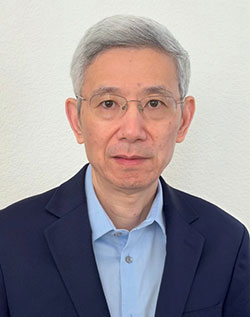
Prof. Shang-Ping Xie
University of California San Diego, USA
University of California San Diego, USA
謝尚平(Xie Shang-Pingシェ・シャンピン)氏は、カリフォルニア大学サンディエゴ校スクリップス海洋研究所のロジャー・レヴェル教授です。
青島の中国海洋大学を卒業後、1991年に日本の東北大学で物理海洋学の博士号を取得されました。
謝氏は、気候変動の反復的なパターンがどのように形成されるか、気候はどの程度予測可能か、
そして大気中の温室効果ガスの増加に伴い気候がどのように変化するかといった、
基礎的な課題の研究に取り組んでおられます。
謝氏は、2013年に公表された気候変動に関する政府間パネル(IPCC)第5次評価報告書の主執筆者の一人です。
またアメリカ地球物理学連合(AGU)のフェローであり、
2017年には「気候変動と気候変動に関わる海洋・大気結合フィードバック過程の理解に対する基礎的な貢献」が評価され、
米国気象学会からスヴェルドルプ金メダルを授与されました。
Abstract
Most of our planet has warmed, but the eastern tropical Pacific Ocean surface has mysteriously cooled during the satellite era of 1982-2024. What’s troubling is that global climate models fail to simulate this distinctive pattern. We developed a novel numerical experiment by forcing global models with observed wind stress. The experiment faithfully simulates the multidecadal trend pattern in the tropical Pacific. Detailed analysis indicates that unforced internal variability dominates the tropical Pacific change observed during the satellite era, impacting multidecadal trends in the Asian summer monsoon and North Pacific marine heat waves.
Leadership Lecture : 5月27日(水)
Leadership disruption to overcome destruction: Forging system-wide responses to our climate crisis
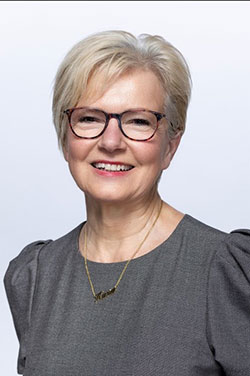
Prof. Karin Markides
Okinawa Institute of Science and Technology
Okinawa Institute of Science and Technology
カリン・マルキデス博士は、スウェーデンのストックホルム大学で博士号を取得し、分析化学を専門としています。スウェーデンのチャルマース工科大学およびアルメニア・アメリカン大学の学長兼CEOを務めた後、2023年6月に沖縄科学技術大学院大学の学長兼理事長に就任し、
2026年4月からは名誉学長兼エグゼクティブ・アドバイザーを務めておられます。
マルキデス博士は、ウプサラ大学の分析化学名誉教授を任命されているほか、スウェーデン王立工学アカデミー(IVA)およびスウェーデン王立科学アカデミー(KVA)の選出会員でもあり、同アカデミーではノーベル化学賞の選考や、社会、学校、学術界に向けた科学の普及活動に携わってこられました。
Abstract
As researchers we are frustrated, impatient, surprised, sad, and angry about the perceived slow transformation in society. The universities have, however, the power to increase societal engagement using interdisciplinary intersections, multi-stakeholder partnerships, transformative innovations, local and global alignment, and developmental leadership. Knowledge alone cannot break the traditional barriers of economic, cultural, and personal drive. Exploratory projects will be needed, guided by the attitude that Nelson Mandela stated "I never lose. I either win or I learn". Benchmark examples and key messages will be used with the aim to spark and inspire time-sensitive academic leadership needed in society.
Frontiers of Science Lecture : 5月28日(木)
On Beginnings: Early Earth, Life, and the Practice of Scientific Creativity
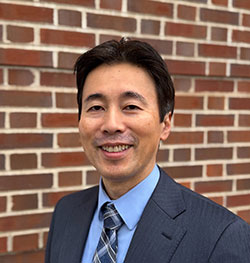
Prof. Jun Korenaga
Yale University
Yale University
是永博士の研究の多くは、地球物理学や惑星科学における幅広い課題に及び、物理学、化学、応用数学、統計学を組み合わせ、長年の未解決問題に基礎的な視点から再アプローチするものです。彼の研究哲学は意図的に広範かつ統合的であり、地球を孤立した構成要素の集合体ではなく、相互に連関したシステムとして理解しようとするものです。
是永博士は、自らを「フリースタイルの地球物理学者」と称して、マントル対流、プレートテクトニクス、大陸の成長、惑星形成、 そして太陽系内外の地球型惑星の進化といったテーマに取り組んできました。
これらの多様な分野にわたり、彼の研究目標は、深部における惑星のプロセスが、 いかにして地表環境や長期的な居住可能性を形作っているかを解明することにあります。
是永博士は、自らを「フリースタイルの地球物理学者」と称して、マントル対流、プレートテクトニクス、大陸の成長、惑星形成、 そして太陽系内外の地球型惑星の進化といったテーマに取り組んできました。
これらの多様な分野にわたり、彼の研究目標は、深部における惑星のプロセスが、 いかにして地表環境や長期的な居住可能性を形作っているかを解明することにあります。
Abstract
Earth’s history spans four geological eons, yet our ability to reconstruct that history fades rapidly with age. The earliest interval—from the Moon-forming impact to the oldest preserved rocks—remains particularly enigmatic. Understanding this formative period is central to one of the most profound questions in science: how life began on our planet. In this lecture, I will discuss how seemingly simple questions about Earth’s present state can illuminate deep planetary processes and early environments, showing how fundamental questions about Earth remain fertile ground for discovery by the next generation of scientists.